
Whether you’re hearing nutrition advice from your doctor, your favorite health influencer, our political administration, or even popular nutrition research, it is highly likely you are being warned of the dangers of ultra-processed foods. “A diet high in processed foods” almost always takes the blame for poor health, weight gain, and the prevalence of all kinds of medical conditions in the United States. Recent headlines such as “Every bite of ultra-processed foods may increase risk of early death”(1) have stoked the flames of fear around these foods that we see and eat every day.
Is this fear warranted?? Are all processed foods really damaging our health? Or is this phenomenon successfully distracting from larger issues that contribute to our health and well-being? To determine this, you have to look at the research! And it turns out, you don’t have to look far to see the issues. Most research about processed food consumption is confusing, leaves out important factors, and does not conclude with a helpful solution.
The most obvious confusion in the research is the fact that the definition and categorization of unprocessed, processed, and ultra-processed foods has changed eight times since we started using this language in nutrition research! The different definitions since 2009 include:
- include food substances not used in culinary preparation (2)
- having more than 5, and usually multiple, ingredients
- ready to eat or ready to heat
- formulated mostly from ingredients and typically contain no whole foods
- ultra palatable, often habit forming
It’s no wonder that this confusing language has lead to people not knowing what the heck an ultra-processed food is. Ready to eat? An apple. More than 5 ingredients? My mom’s delightful vegetable soup. Often habit forming? I habitually eat lots of nourishing foods I love. Having lots of ingredients or being really delicious does not inherently make a food unhealthy. Vice versa, a food is not inherently healthy if it is homemade or contains few ingredients.
Remember: the supplements, green powders, and protein shakes that the same influencer who demonizes processed food sells you, ARE highly processed foods.
Harvard Health, a source that you would think would be very scientific and informative, recently shared a table to help readers identify and choose less processed foods (3):
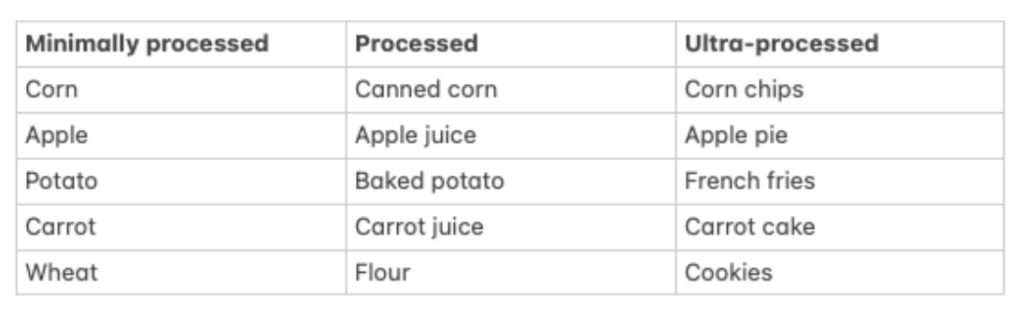
So helpful right? Instead of choosing carrot cake, eat carrots. Instead of choosing cookies, eat wheat? Just a few problems I see with this:
- Comparing apple pie to apples, and carrot cake to carrots is not a fair comparison. Is is the fact that it’s the more processed version that makes it less healthy, or is it the fact that those are completely different foods?
- Simply writing “cookies” makes readers assume that all cookies are highly processed, and therefore, bad for you, and this just isn’t true. There are thousands of kinds of cookies and they all lie on a spectrum of nourishment.
- Corn chips ingredients are: corn, vegetable oil, salt. Only 3 ingredients and nothing “not used in culinary preparation”. Sure, things like corn chips probably come to mind when people think of ultra-processed foods, but they don’t quite fit all the requirements, do they?
- Highlighting baked potato as the more processed version of a potato is just hilarious. No one is eating a raw potato!
What this confusion and misleading means is: we have to take the nutrition research with a grain of salt (for lack of a better term).
The majority of large nutrition studies get their data through asking participants about their food intake. If the participant is unsure about what a processed vs. ultra-processed food is (like we all are) their answers are going to look very different from someone else.
So the recent CDC report that showed that “Americans get 55% of their calories from ultra-processed foods” really means that Americans get 55% of their calories from what they assume are ultra-processed foods, and this is going to look different for everyone (4). This statistic is being used right now to create food policy in our country, and the research that created it didn’t even account for differences in socioeconomic status, geographic location, income, or education level.
**I also think it’s worth noting that this isn’t a number that surprises or worries me. A diet that is 55% canned soups, crackers, energy bars, lunch meat, cereal, sauces, cookies, ready to heat meals could be extremely healthy and balanced.
Because they are often affordable, readily available, and usually higher in energy than whole, unprocessed foods, people who are most likely consuming more highly processed foods are:
- lower income
- people with disabilities
- living in a food desert (limited available stores and fresh foods)
- have little time, energy or ability to prepare meals for a family
These marginalized groups are also more likely to face other challenges related to health and would benefit more from interventions such as access to quality healthcare, a living wage, access to affordable fresh foods, free public transportation, and access to/time for joyful movement. So research that indicates higher level of processed food consumption leading to poorer health must consider the other variables that could be contributing to this. System-level public health interventions would do a lot more for overall nutrition status than eliminating or restricting processed foods would.
A food undergoing processing does not necessarily make it unhealthy, and neither does combining a bunch of ingredients to make something. Yes, some foods lose some of their nutrient content when they are refined or broken down. And some foods contain lots of sugar and little fiber, vitamins, and minerals. But this is not the case for all foods that are highly or moderately processed, and lumping them together into one big category to be avoided will likely lead to less nutrition and variety in one’s diet.
At Feeding Your Soul Nutrition, we use processed foods to increase the nutrients, ease, variety, affordability, and joy in our own diets!
- Lauren likes to combine frozen soup dumplings with a bag of fried rice for an easy dinner after a long work day
- Jackie uses already seasoned proteins so she doesn’t have to do it herself, and loves to snack on cereal bars
- Courtney’s go-to meal when she doesn’t want to cook is the Trader Joe’s butter chicken microwavable meal, and Emily’s is a frozen pizza
- Haley likes to add frozen chicken tenders to salads, and frequently uses pre-made orange sauce to make meals more flavorful
Being able to make choices that feel good for your body is so important, so if you choose to be mindful about incorporation of processed foods, that is fine! But when someone demonizes or recommends restriction of them, take a second to question the intentions, privilege, and research flaws behind it. Is the restriction of a gigantic and very nuanced category of foods really going to positively impact your health, or is it going to make your life, and relationship with food, much harder and more confusing?
References:
- Brown, S. (2025, May 5). Every bite of ultra-processed foods may increase risk of early death, study says. Verywell Health. https://www.verywellhealth.com/ultraprocessed-food-will-increase-your-chance-of-an-early-death-11725319
- Gibney MJ. Ultra-Processed Foods: Definitions and Policy Issues. Curr Dev Nutr. 2018 Sep 14;3(2):nzy077. doi: 10.1093/cdn/nzy077. PMID: 30820487; PMCID: PMC6389637.
- Katherine D. McManus, M. (2020a, January 9). What are ultra-processed foods and are they bad for our health?. Harvard Health. https://www.health.harvard.edu/blog/what-are-ultra-processed-foods-and-are-they-bad-for-our-health-2020010918605
- Williams AM, Couch CA, Emmerich SE, Ogburn DF. Ultra-processed food consumption among youth and adults: United States, August 2021–August 2023. NCHS Data Brief. 2025 Aug;(536)1–11. DOI: https://dx.doi.org/10.15620/cdc/174612